Showing posts with label life. Show all posts

Sunday, February 2, 2014

Michael Onsando visits Kampala

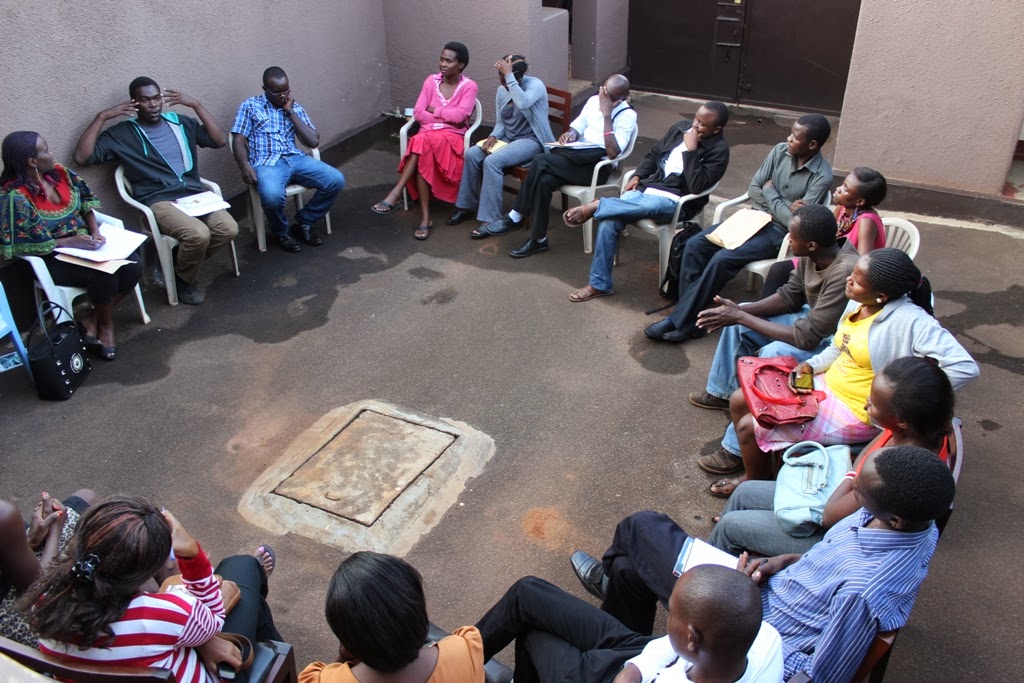
Photo credits: All photos with Michael and Femrite members in discussion, photos by Dilman Dila.

Photos of Tom Forrest, Michael Onsando and scenic view of Buziga Hill, photos by BNN. Photo gallery of the visit coming soon.

BN Poetry Foundation recently partnered with Femrite, Transcultural Academy and Poetry-in-session to bring Kenyan poet and blogger, Michael Onsando to Kampala. The fully packed literary itinerary included a very late night bus ride, dinner at Wandegeya’s finest, a heavy Q and A at Femrite Author of the Month session, relaxed evening at Poetry in session and a day out at Tom Forrest’s house with an unbeatable view of Kampala. Delightful. Yes, indeed.

Michael is the first of several other East African poets who will be travelling to Kampala in the next couple of years for cultural exchange visits which are sponsored, authored and managed by Africans and Afrocentric non-Africans.

On arriving close to 11:00pm on 26 January when the rest of Uganda had long slept after celebrating, or not, the 28th anniversary of the ruling National Resistance Movement, the first part of this extraordinary visit was to Wandegeya. It was the only suitable place for fine food at such a fine hour. Wandegeya is adjacent to Makerere university and caters for all sgudent needs. Michael, coming from Western Kenya, adores matooke and binyeebwa, which made my life so much easier. His guest house in Ntinda was not far off in the traffic less city, close to midnight.

During the day of 27th, he toured a little and chanced upon Afriart gallery which true to its name, held fine art exhibitions and craft, which raised our guest’s expectations of Kampala’s art. The gallery is run by Daudi Karungi and every month, there is an exhibition of a different artist be it painter, scuptor, bark cloth genius or oilsmith.

Femrite’s evening session of Author of the month occurs every last Monday. This was the first serious literary space that Michael entered and was nothing short of spectacular. Having followed his blog at www.michael.co.ke, there were a number of questions I had, given his vulnerability and social awareness, reflected off these pages. The members at the discussion filled the session with lots of questions of their own as well.

Q: On your blog, you mention how you were incapable of celebrating Kenya at 50 in 2013. This is in reference to the 50th anniversary independence from British rule. Why weren’t you able to celebrate with the rest of the nation?

A: Why should I celebrate when there is so much injustice. For example, an open air market was razed for having been built on illegal ground but Westgate Mall was also built on illegal ground and never razed.

Q: You have been told that being a poet is not aspiration enough. If you were a decamillionaire, do you think their views would change?

A: Yes, because money has now become an end and not a means to an end.

Q: What is your view on literary prizes?

A: A number of people have been given a platform. Prizes do not validate the work and they are only as good as the judges. They are also mainly of value to those giving them and not to those receiving them, in my opinion. They are a grey area and have done more harm than good. In Africa especially, writers are only validated by prizes and yet even without a prize, writers remain excellent at their craft.

Q: Does everyone have talent?

A: Yes, we all have talent. We must not believe that all talent has to be artistic though.

Q: But as a teacher, I have had to let down some of my children who have no talent in poetry by telling them to try another specialty. A: As a teacher though, it is your duty to encourage that child no matter what to pursue poetry, if it is in her/his interest.

Q: When writing a poem, do you pay attention to particular rules? A: For a long time, I paid attention to rules and metre but even though everything is new, we must still be deliberate and not just let things happen.

Q: Uganda is a literary drought. What can we do to change this and market ourselves as well as Chinua Achebe and Ngugi wa Thiong’o?

A: Who are you reading? Uganda and East Africa are far from literary droughts. There is a lot of work coming out for example, Dust by Yvonne Adhiambo Oduor, which I recommend all to read.

Q: Chinua Achebe and Ngugi wa thiong’O did not remain on the continent to and take part in the real struggle? What do you make of this?

A: Look at the circumstances that make them go away. Ngugi was in a very precarious political and personal state. After his first return, his wife was raped brutally and there were many other political repercussions.

Onsando also believes that we are fundamentally gifted by largely one specific thing be it poetry, carpentry, archery. A number of participants at the session disagreed. This rose from the fact that many writers and artists take on several other roles to sustain them financially.

After reading three memorable poems namely Whispers, Unlearning Death and Maktub, the evening ended with more questions which could only be concluded at another forum. It was an impressive, reflective and ebergetic evening at Femrite. Tuesday’s Poetry in session was more relaxed. With a few regulars and some new faces, Roshan Karmali, the host and founder, allowed each poet a maximum of 3 poems and to engage the audience more. This was a fantastic way to begin the new year as she led us to a theme of breaking new as opposed to finding ourselves in 2013. It was a night of pleasant surprises, concluded by the gifted Bosco and his guitar. Singing some of my favourite songs like, How does it feel to be the on that I love?”p>

After many late nights, Wednesday was resting day at Tom Forrest’s exquisite house on top of Buziga Hill, overlooking the extraordinary Kampala city. At his place which is spruced up with an enchanting mix of flowers, shrubs, old trees, roots, guava trees, trees hanging with leaves commonly called Old Man’s Beard, hibiscuses of all shades and rare cacti, we allowed ourselves to seep in the new and the fresh.

Tom Forrest is a distinguished Biritish academic who hoards literature, mainly poetry. Fascinating. A welcome alternative from the engaging previous two nights. Visiting with Femrite members Jackee Batanda and Sophie Alal who are writers,creators and entrepreneurs, Tom was only too delighted to host an East African writer at his premises.

Michael’s wish is to return to Kampala as soon as possible.

Many thanks to sponsors and friends who made this visit possible, the first of many.

By Beverley Nambozo Nsengiyunva

Friday, March 15, 2013

Too Much sweetness at AWT International Writers’ Conference.

The first story that was told at the Writers’ Conference, which none of us will ever forget did not come from Prof. Jack Mapanje, or Nii Parkes, but from two prostitutes. A Norwegian man died after a night with two prostitutes. Upon their arrest, the prostitutes said that the man must have died from too much sweetness. From 7 to 9 March 2013, African Writers’ Trust organized an international writers’ conference in Entebbe. The Director, Goretti Kyomuhendo, resident in the UK, created this space for us to talk, write, learn and create. It was unforgettable. The dominant theme at the conference was Afropolitanism and the question of continental identity with the mobility of Africans all over the world. There have been large exoduses from decades and decades ago for reasons ranging from seeking alternative education and economic opportunities, tourism, escaping political strife and so on. And then there were questions about returning to the continent and if it really did feel like home. In his keynote address, Prof. Mapanje, renowned Malawian poet did not have a solid answer as to whether returning to Malawi after two decades in the UK, really felt like home. The conference had several writers from the diaspora whose names were followed by Accra/UK, DRC/Norway, DRC/Netherlands and Uganda/UK. This is the real situation of many who have lived and continue to live across two continents and for many reasons, unable to identify one single country as their home. It is an indisputable reality and one that I learned from after hearing their stories of challenges of living as a writer in the West. Contrary to the justification many of us try to give ourselves when we are not writing or pushing our creativity beyond its limits, we who live here want to believe that ‘they’ in the West, have it easier because they live next door to publishers, dine with literary agents and have coffee with prize givers. Hardly. They too have 24 hours in the day with which to work and create, have children to look after and bills to pay. Did I mention that the weather most times in unfavourable and can be compared to Margherita peak on Mt. Rwenzori. And nothing brought made this clearer than the readings from Kwani? 07, which Doreen Baingana and Kalundi Serumaga opened up to us. Billy Kahora, managing Editor of Kwani? led a very reflective session and explained the motivation for the theme for the latest edition of the East Africa literary journal, Kwani?, which was Africans in the diaspora Doreen’s was a true account of being mistreated at the immigration department before entering the United States. The confrontation by the officials because of the choice she made not to apply for US citizenship and instead return to Uganda, resonates the binary standards of immigration policies. The disparity between the West and the beautiful and complex continent of Africa is further examined in an article by Alphonse Muambi, Congolese journalist currently residing in The Netherlands. The articles entitled, African elections, a naïve European ideal? indicates that the European desire for democracy on the continent is detrimental to the well-being of African populations. There was a lot of discourse as well about how we can collaborate as writers to use available digital tools to widen our audiences and opportunities for publishing and listening to Chikoti’s views on this and his Malawi experience as well as Rais Boneza from Norway/DRC, Dwalu, a children’s author from Liberia and even the Ugandan writers like Beatrice Lamwaka, Hellen Nyana, Harriet Anena, Baingana and Twongyeirwe. It is safe to say that we must tap into the prospects from the internet and keep on writing. The conference was followed by many other events in Kampala, one of which was an African Writers’ evening organized by Nii Parkes, which he runs in England on a quarterly basis. And true to the celebration of Women’s Day, Beatrice Lamwaka read from two different anthologies and bravely bore the Q and A from the audience. Rais entertained us with an oral form of poetry in singing verse and Nii, true to his amazing self, ended on a high with the West African mosquito, detailing the issues of youths in America who live and think like gangsters but are no match for the perils of malaria. Goretti Kyomuhendo is farsighted. The session with employees from Barclays Bank and Stichting Doen, the sponsors of the event, discussing possible collaboration with the literary arts is testimony to this. She embraces challenge with a dignified fierceness and I am so grateful. I am honoured to have met astounding writers from Uganda, the entire continent and the diaspora, from whom I picked incredible wealth for my own writing. Asanteni! By Beverley Nambozo Nsengiyunva

Friday, January 18, 2013

making money in 2013

After 4 years of being a stay at home mum, completing my Masters and holding 4 successful annual poetry awards for Ugandan women, I am now ready to start making money. How am I going to do this?
I am not an aggressive business woman; neither do I own property across Naguru which I can sell. I have never been a Member of Parliament in Uganda. Going the old-fashioned job hunting way? Well the thought did cross my mind. I am actively seeking ways to make money while still maintaining my poetic, children-loving self. This is the year for me. 2013 is the year. If not this year, then when? If not me, then who? That’s a quote I got from Muthoni Garland of Storymoja in Nairobi. She said, that if you want to start something, ask yourself, if not me, then who? I love that-living on edge, taking risks, thinking bigger than my super ego. I am now in this remarkable place called Life which no capitalist, theorist or theologist has defined. It is my space. Need to make it right this year. I need to get this right. Happy New Year.

Monday, December 17, 2012

For Sarah Baartman-poem by Serubiri Moses

For Sarah Baartman By Serubiri Moses I have come to take you home where the ancient mountains shout your name. I have made your bed at the foot of the hill, your blankets are covered in buchu and mint, the proteas stand in yellow and white – Diane Ferrus I am coming back home. Sheets of volcanic rock lean over me like tree branches, Shielding my mouth from glaring sun, soothing my feet like a babe in bosom, I am home on these black rocks that bear markings of my forefathers, on which earth they planted trees and manicured lawns, where zebras melt into the zen-like quietness of the landscape in deep grayish browns. I am home trekking the valley with my goats, sheep and cattle. Sarah, our black bodies have left the museums now. My black body has found its silence here among the crater lakes. I return from the place where black bodies are fetishized like fertility dolls, soiled with white semen, and white curses to those to whom Black Beauty must be tamed and groomed. Sarah, I am home in Naivasha on the volcanic bench, where vapor rises from the hot tarmac like morning fog in the rain. Sarah, I am home where The road is a long tongue that drinks up the rain with a terrible thirst.

Tuesday, August 28, 2012

Feminist Leadership Institute Novemver 2012, Nairobi

The fourth Feminist Leadership and Movement Building Institute is a five-day course designed to strengthen feminist leadership, strategies, and collective power for social transformation in Africa.
The leader of an elephant pack is a female, called the Matriarch The Institute will combine reflection on the current political landscape as well as past organising strategies for women's rights in Africa by using a trans-movement building approach. Looking at diverse movements in Africa and globally, participants will be able to relate some of the experiences and lessons from these movements to their own contexts, countries, and regions. This Institute will be held in collaboration with GROOTS Kenya and Akili Dada. Course Content The movement building approach challenges groups to critically assess how they have organised themselves to achieve their social justice goals. In particular, it enables participants to explore their political agenda, involvement of constituents, and strategies for collective action underpinned by reflection. Using a movement-building lens, the process will allow participants to build their knowledge on the theoretical underpinnings of movement building, synthesised from analyses of global movements. Additionally, participants will identify the different intersections, interactions, common spaces, and challenges that social movements encounter when collaborating on issues of women's human rights. From this, they will critically assess pre-existing resources of the women's movement in Africa. They will also identify and explore concrete strategies to strengthen links between movements to advance women's human rights more collectively. The Institute will cover the following topics: - Social movements and power-concepts and theory - Movements, organizations, and leadership-theory and practice - Current issues and challenges of the women's movement in Africa - Women in peace and conflict resolution - Women's political participation - Assessing our impact-approaches and tools The Institute will foreground reflection at the personal and institutional levels, which will both enable and challenge participants to strengthen their leadership skills and strategies to effect real change for women's rights and social justice in Africa. Participants To participate you must: - Be a woman between 25 and 45 years of age - Reside or work in East Africa (Burundi, Djibouti, Eritrea, Ethiopia, Kenya, Rwanda, Somalia, Somaliland, Tanzania, and Uganda)**** - Have a minimum of 3 years of experience working on gender issues, women's rights, development, and/or youth activism (voluntary or employment) - Be able to demonstrate how you will use what you learn at the Institute in your work and how you will continue to participate in follow-up activities - Have a working knowledge of the English language Venue and Dates The fourth Feminist Leadership and Movement Building Institute will be held in Nairobi, Kenya, during 5-9 November 2012 (Begins 9 am on 5 November; Ends 4 pm on 9 November). Travel and Visa Participants are responsible for incurring their travel costs to and from the Institute, and obtaining their own visa. CREA will assist with the visa process by providing a letter of invitation and required visa letters. Costs Tuition, accommodation, and meals for the duration of the Institute will be covered by the organisers. Participants will be required to pay a registration fee of USD 50. Participants must cover their own travel expenses. A limited number of travel scholarships are available on a need basis. Accommodation Accommodation will be on twin-sharing basis. Application Only applicants residing and working in East Africa (Burundi, Djiboutim Eritea, Ethiopia, Kenya, Rwanda, Somalia, Somalialand, Tanzania and Uganda) are encouraged to apply. Deadline: 10 September 2012 Applications are due on or before *10 September 2012*. To apply online, click eminist If you experience difficulty with the online method, download the application from CREA's website (www.creaworld.org) and e-mail the completed form to Sushma Luthra at sluthra@creaworld.org or to CREA at crea@creaworld.org. Send any queries to Ms Luthra as well.

Tuesday, April 12, 2011

If my father had a chance to walk.....

If my father had a chance, he would most certainly have wanted to walk to work, run with his children and even swim in the lake. Unfortunately, for the last 13 years of his life he was unable to. This was not because the police arrested him for walking to work whenever he had a chance but because he was shot by some merciless army men in the late 1970s, after which he led a sedentary life until his death.
Yesterday, I felt like waking him up to tell him that now I can’t walk. Of course, he would have been concerned...have the buggers done it again? Have they shot you too? But no, dad, I wasn’t shot, nobody shot me, the buggers just arrested me.
“What?” my dad would have said. They arrested you for walking?” Were you trespassing?”
“No, dad, I was just walking to work. I had my laptop on my back and comfortable shoes and the police arrested me, okay not just me, there were a bunch of us.”
“Nambozo were you doing anything illegal?”
“No, dad, it’s just that the fuel prices have really gone up and food is exhorbitant. I’ve even started planting maize and beans at home because I can hardly afford buying from the market anymore.”
“Nambozo, I thought things were better now with this President?”
“Dad, there’s just so much you don’t know. I’ll tell you all about it when we meet, which won’t be soon. Maybe that time, we’ll have a new President, who knows?”
“Dad, when you were young, did Africa still have a problem of leaders not wanting to let go?”
“Ha ha Nambozo, Africans are good at heart but you must understand that when poor people suddenly get a hold of money, they don’t know how to use it wisely and so need more and more because it keeps running out.”
“Okay, Dad now I understand. And money is symbolic for wealth, but also power, right?”
“Yes, dear.”