Showing posts with label poetic days. Show all posts

Sunday, February 2, 2014

Michael Onsando visits Kampala

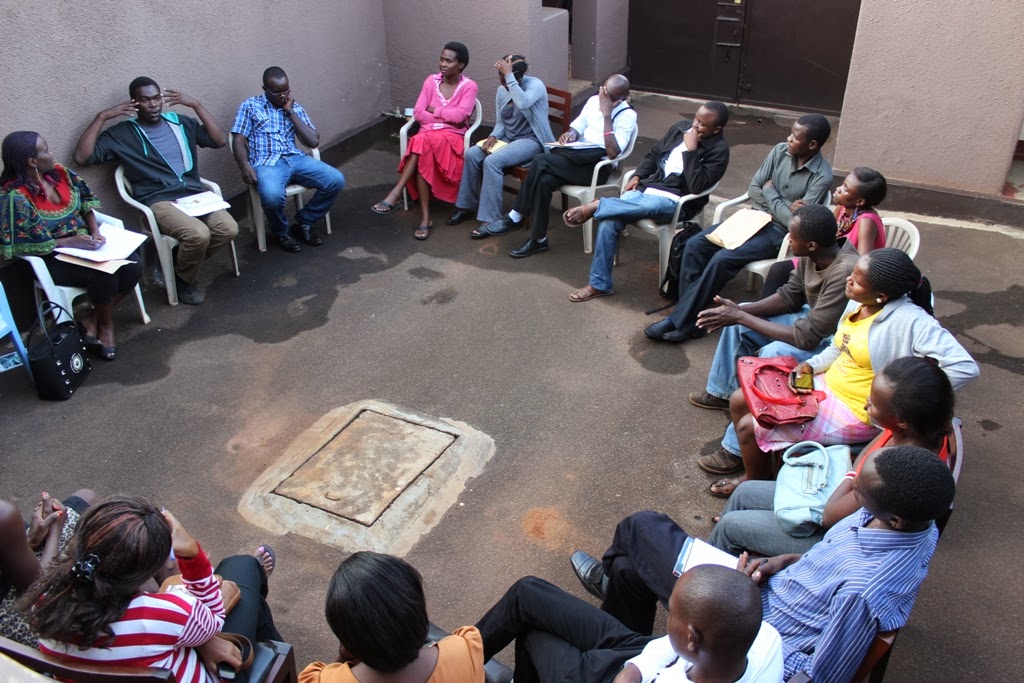
Photo credits: All photos with Michael and Femrite members in discussion, photos by Dilman Dila.

Photos of Tom Forrest, Michael Onsando and scenic view of Buziga Hill, photos by BNN. Photo gallery of the visit coming soon.

BN Poetry Foundation recently partnered with Femrite, Transcultural Academy and Poetry-in-session to bring Kenyan poet and blogger, Michael Onsando to Kampala. The fully packed literary itinerary included a very late night bus ride, dinner at Wandegeya’s finest, a heavy Q and A at Femrite Author of the Month session, relaxed evening at Poetry in session and a day out at Tom Forrest’s house with an unbeatable view of Kampala. Delightful. Yes, indeed.

Michael is the first of several other East African poets who will be travelling to Kampala in the next couple of years for cultural exchange visits which are sponsored, authored and managed by Africans and Afrocentric non-Africans.

On arriving close to 11:00pm on 26 January when the rest of Uganda had long slept after celebrating, or not, the 28th anniversary of the ruling National Resistance Movement, the first part of this extraordinary visit was to Wandegeya. It was the only suitable place for fine food at such a fine hour. Wandegeya is adjacent to Makerere university and caters for all sgudent needs. Michael, coming from Western Kenya, adores matooke and binyeebwa, which made my life so much easier. His guest house in Ntinda was not far off in the traffic less city, close to midnight.

During the day of 27th, he toured a little and chanced upon Afriart gallery which true to its name, held fine art exhibitions and craft, which raised our guest’s expectations of Kampala’s art. The gallery is run by Daudi Karungi and every month, there is an exhibition of a different artist be it painter, scuptor, bark cloth genius or oilsmith.

Femrite’s evening session of Author of the month occurs every last Monday. This was the first serious literary space that Michael entered and was nothing short of spectacular. Having followed his blog at www.michael.co.ke, there were a number of questions I had, given his vulnerability and social awareness, reflected off these pages. The members at the discussion filled the session with lots of questions of their own as well.

Q: On your blog, you mention how you were incapable of celebrating Kenya at 50 in 2013. This is in reference to the 50th anniversary independence from British rule. Why weren’t you able to celebrate with the rest of the nation?

A: Why should I celebrate when there is so much injustice. For example, an open air market was razed for having been built on illegal ground but Westgate Mall was also built on illegal ground and never razed.

Q: You have been told that being a poet is not aspiration enough. If you were a decamillionaire, do you think their views would change?

A: Yes, because money has now become an end and not a means to an end.

Q: What is your view on literary prizes?

A: A number of people have been given a platform. Prizes do not validate the work and they are only as good as the judges. They are also mainly of value to those giving them and not to those receiving them, in my opinion. They are a grey area and have done more harm than good. In Africa especially, writers are only validated by prizes and yet even without a prize, writers remain excellent at their craft.

Q: Does everyone have talent?

A: Yes, we all have talent. We must not believe that all talent has to be artistic though.

Q: But as a teacher, I have had to let down some of my children who have no talent in poetry by telling them to try another specialty. A: As a teacher though, it is your duty to encourage that child no matter what to pursue poetry, if it is in her/his interest.

Q: When writing a poem, do you pay attention to particular rules? A: For a long time, I paid attention to rules and metre but even though everything is new, we must still be deliberate and not just let things happen.

Q: Uganda is a literary drought. What can we do to change this and market ourselves as well as Chinua Achebe and Ngugi wa Thiong’o?

A: Who are you reading? Uganda and East Africa are far from literary droughts. There is a lot of work coming out for example, Dust by Yvonne Adhiambo Oduor, which I recommend all to read.

Q: Chinua Achebe and Ngugi wa thiong’O did not remain on the continent to and take part in the real struggle? What do you make of this?

A: Look at the circumstances that make them go away. Ngugi was in a very precarious political and personal state. After his first return, his wife was raped brutally and there were many other political repercussions.

Onsando also believes that we are fundamentally gifted by largely one specific thing be it poetry, carpentry, archery. A number of participants at the session disagreed. This rose from the fact that many writers and artists take on several other roles to sustain them financially.

After reading three memorable poems namely Whispers, Unlearning Death and Maktub, the evening ended with more questions which could only be concluded at another forum. It was an impressive, reflective and ebergetic evening at Femrite. Tuesday’s Poetry in session was more relaxed. With a few regulars and some new faces, Roshan Karmali, the host and founder, allowed each poet a maximum of 3 poems and to engage the audience more. This was a fantastic way to begin the new year as she led us to a theme of breaking new as opposed to finding ourselves in 2013. It was a night of pleasant surprises, concluded by the gifted Bosco and his guitar. Singing some of my favourite songs like, How does it feel to be the on that I love?”p>

After many late nights, Wednesday was resting day at Tom Forrest’s exquisite house on top of Buziga Hill, overlooking the extraordinary Kampala city. At his place which is spruced up with an enchanting mix of flowers, shrubs, old trees, roots, guava trees, trees hanging with leaves commonly called Old Man’s Beard, hibiscuses of all shades and rare cacti, we allowed ourselves to seep in the new and the fresh.

Tom Forrest is a distinguished Biritish academic who hoards literature, mainly poetry. Fascinating. A welcome alternative from the engaging previous two nights. Visiting with Femrite members Jackee Batanda and Sophie Alal who are writers,creators and entrepreneurs, Tom was only too delighted to host an East African writer at his premises.

Michael’s wish is to return to Kampala as soon as possible.

Many thanks to sponsors and friends who made this visit possible, the first of many.

By Beverley Nambozo Nsengiyunva

Friday, April 26, 2013

Betty Kituyi, 3rd winner of BN Poetry Award 2012, in an interview.

Betty Kituyi was 3rd in the 2012 BN Poetry Award. BN stands for Babishai Niwe and formerly , was Beverley Nambozo Poetry Award, now in its fifth year. What is your academic and occupational background? (What you do for living). To many of my writing friends I am seen as a writer who marries science and art. I have a strong science background with an MSC in Chemistry and I am now a national coordinator of CafĂ© Scientifique – Uganda. The project targets young people in secondary schools and gives them an opportunity to meet science experts informally at the school to explore interesting and new ideas on science and technology. Before this project, I have taught science subjects at secondary school and university levels. I continuously make a double flow between science and art and my work experience runs from science research, education, public engagement, creative writing, poetry, editorial practices and publishing. When have you been writing poetry and how many poems have you written? My writing journey began as early as 8 years of age when I started writing in my school notebooks about the lessons I was learning about events around me and how I felt about them. My uncle, Malomo, kept a small hard cover red notebook in which he wrote about his brother’s family (our family). In this book, there were records of child births, famine and harvest and other things I do not remember now. This little book became a treasure to our family when we would gather around a paraffin lamp on many nights to read its contents. The book inspired me to keep a record of things. When I grew older and I leafed through the scribbling in my notebooks, I realised that they were poems. But I began seriously writing poetry in 2001 – 2003 when I became a student on the Crossing Borders program by the British Council. This was an extensive online writing program that involved Ugandan writers on a cultural exchange with established writers from the United Kingdom. I developed 60 poems from this scheme but I have written over 100 poems. What other poetry award have you won? Or how else has any of your poems been publicly recognised or used? In 2002 my poems Third World Champion and In Touch were winning daily poems on the BBC Network Africa poetry competition aired on the morning radio broadcast. In 2010 my poem, A place, was published in The Butterfly Dance by Femrite Publications Ltd. In 2009 my poem, Hibiscus, was published in The Painting Voices poetry anthology by Femrite Publications Ltd. I have recited my poetry at different writing forums including the recently held LittWorld 2012 International conference. What draws you to poetry? Is there any a special feature or aspects of poetry that makes you drawn to it? Poetry works for me because I am always attracted to what lines the surface of things. When I look at a burning candle, I am attracted to its dancing flame and its enduring burning wick. It stirs images in my life and where I am standing at that point - whether my candle will keep burning despite the stormy currents surrounding it. The candle therefore carries a strong spiritual symbol for me and it is only poetry that can embody its short lived story for me and that works. What is the story behind your poem FALLING? What lines or a stanza of the poem has a strong bearing on your personal life? Here is Falling: Falling The rain is gently clapping at the rocks outside my kitchen. Its music waters my desert. A new song forms, the sound of raindrops washing my face. The rain is steadily taking me home by twilight. I am learning from the weeping clouds that falling isn’t dying. I wrote this poem when I was down with Migraine and in a lot of pain. The rain just kept pouring steadily and gently the whole of this day and it was perfect weather for my condition. As I stood at my kitchen sink to watch it, I found I liked the way it fell – gently - and how it was received by the rocks. There was music in all that and I liked it. It healed me. Then I heard a knock on the door and Moses my fiancĂ© stood tall before me – the rain had steadily brought him home – I cried. But it is the last stanza that surprised me - ‘I am learning from the weeping clouds that falling isn’t dying’. Those words just came to me after so much editing of the poem and they resonated with me and stood strong and powerful in meaning. Later at the Beverly Nambozo 2012 Awarding ceremony, everybody was talking about Bududa and the rain and the mudslides. Then it occurred to me that my poem was prophetic – as I stood up to give my speech as a third winner, I told the audience that I came from Bududa and they were so surprised. But I also told them, ‘the rain fell in my village and my people died yet my poem said that falling isn’t dying’. At that moment I began to believe that the poem had a personal message for me and my people – ‘May be there was a meaning to this death in my village, may be dying is not the end.’ I told the teary audience. Follow this story here: http://www.doenculture.com/2877/en/betty-kituyi-3rd-winner-of-bn-poetry-award-2012 What made you submit the poem for the competition? Did you entertain any inhibitions as you submitted your work? I looked at the prizes and they were good. The theme was music and my poem had music in it even though it wasn’t obvious. I had done my homework to put every word and every line in its place. So I knew that my poem stood a chance to win. I did not entertain any inhibition whatsoever. Just like a mother lets her child to face the world one day, the moment had come for me to send my poem out there to speak for its self. I had no control over how it would be charged but I had given it a chance to be – a poem - and that worked. What has the success of this poem, FALLING, done to your literary outlook (or attitude to writing)? I have learnt to pay attention to the small moments that happen in my life – my poem which began at the kitchen sink has travelled vast distances across the world and is being read by students and people from all walks of life. This has humbled me and uplifted me at the same time to write and share my work the more. What kinds of writing do you do beside poetry? Any example of writing in any genre? I have written journalistic pieces that have been published. I do thematic writing and currently I am writing around Christian themes: March 2010 How Boys and Girls Think Differently, an article published by the ObserverNewspaper: HYPERLINK "http://www.observer.ug/index.php?option=com_content&task=view&id=7738&Itemid=106" http://www.observer.ug/index.php?option=com_content&task=view&id=7738&Itemid=106 2010 My Basuben, a short story on Female Genital Mutulation was published in the Beyond the Dance anthology in by Femrite (Uganda Women Writers Association) Publications Ltd. What motivated you into writing and what factors are propelling this motivation for keeping on writing. I have a thirst for stories – I am always reading books. There was a year when I looked at the volumes of books I had read and decided that I needed to start writing my own books. From that point on, I still read but I also write. Being a member of Femrite (Uganda Women’s Research Association) and Faith Writers Association has helped me to meet other writers who continue to encourage and inspire me to write more. Being part of 2012 LittWorld made it clear for me to write my faith story for Uganda and the world. What challenges do you face in your personal writing life? It is not always easy having to switch from the experimental world of science to the feeling world of poetry and storytelling. The two worlds are completely different. The discipline to sit down and complete a writing project is a challenge for me. As a mother and a wife, how does family life affect, enhance, or diminish your writing? My stories are many times intertwined with my family life – yesterday my eight year old son told me a story about a pencil thief and pencil collector in his class. His description of these two kids were so vivid, I came back to them many times later in the day. I know that this story will find its way in Memoirs of A Son – a book I am writing on my young son’s view of the world. My family life enhances my writing to spring from the heart. What is your role on the Uganda Faith Writers Association and what personal vision do you have for what the Association can become? I am one of the two founder members of the association. Currently I coordinate the association activities. My personal Vision is to see Faith Writers become a home of Christian Writing and Publishing in the Country, where writers’ talent is nurtured and harnessed into concrete books that will tell the Ugandan Christian Faith story to the world and for future generations.

Monday, February 4, 2013

Dr. Iddah Otieno seeking poets and short story writers

(D
I (Dr. Otieno) am looking for short stories and poems for an edited collection of contemporary short stories and poems from East Africa. The dawn of the new century has witnessed significant changes in the socio-economic, political, and cultural landscape in the East African region. The purpose of the proposed volume is to highlight these experiences from East Africa's colonial past to neo-colonial present through short stories and poems. Suggested topics may include, but are not limited to, themes of alienation, search for identity, the changing face of East Africa, education is a changing society, African families in transition, globalization and information technology, among other thematic areas. Contributors should send completed short stories (7-10 pages double-spaced ) and poems (1-2 pages double-spaced) , 12 points Times New Roman to Dr. Iddah Otieno via e-mail at Iddah.Otieno@kctcs.edu by May 30, 2013. Contributors will be notified by June 15, 2013. Any questions should be directed to Dr. Iddah Otieno via e-mail. Please share this with your colleagues. Let me know if you have questions. All entries must include: (1) author name; (2) institution of affiliation; (3) rank; (4) area of expertise; (5) e-mail contact; (6) a 50 word author biography. Thanking you in advance. Dr. Iddah Aoko Otieno, Ph.D. Associate Professor, English Department Director, Kenya Exchange Program Bluegrass Community & Technical College 101 Academic Technical Building Lexington, Kentucky 40506-0235 Office: 859 246 6341 E-mail: Iddah.Otieno@kctcs.edu Http://district.bluegrass.kctcs.edu/iddah.otieno/ Http://www.bluegrass.kctcs.edu

Sunday, January 6, 2013

2013 BN POETRY AWARD-GRAND FINALE FOR UGANDA

The 5th and final BN Poetry Award for Uganda.
Theme: Innovation As we celebrate the 5th and final BN Poetry Award for Uganda, the theme of Innovation is most suitable because 2013 is about freshness, taking risks, grand gestures and success. In 2014, we’re taking the award to an international level. Guidelines for the award: • The theme is Innovation and you may submit a total of three poems under this theme • The award is open to Ugandan women above 18 years, who are residents of Uganda • The poems must be previously unpublished, written in English and sent as word attachments in Times New Roman Size 12, single-spaced • Submit poems by email to bnpoetryaward@gmail.com or post to p o Box 34942 Kampala, Uganda • DO NOT add your contact details to the poem, only the title of the poem. Instead, include your name, poems’ titles, email address and phone number in the body of the email • For more details, follow the facebook page, Beverley Nambozo Poetry Foundation or blog: http://bnpoetryaward.blogsot.com or website: www.bnpoetryaward.co.ug • Submissions will be accepted from 7 January 2013 to 5 May 2013 Prizes: The first three will win autographed copies of poetry. The first three winners will also be awarded autographed copies of Diaries of a Dead African, by Chuma Nwokolo, Jr. In September 2013, the winners will furthermore attend a fully sponsored trip to the Storymoja Hay Festival in Nairobi alongside cash prizes of 500 US Dollars, 300 US Dollars and 200 US Dollars respectively to use at the festival.

Tuesday, December 11, 2012

Sacrifice, poem by my friend from Lancaster, Alex Evans

Sacrifice by Alexandra O’Toole Evans We loved the tenderness of this poem by Alexandra, especially its unlikely physical manifestations. A perfect way to start the week. Enjoy! . Sacrifice . When you are out there, hanging from lengths of rope, with nothing but pipes and pieces of corrugated metal to break your fall; and the sea, surrounding you, soothing you, ever threatening to swallow you whole, I am in the kitchen, shaking earth from root vegetables; scraping off their rough skins, before I chop them into pieces and drown them in scalding water. . Do you think I don’t know the risks you take? Guilt and uselessness gnaw at me every day. So I make lists, and tick things off as I go, charting my success in crosses out and cups of tea; marking my days with memories made digital and sending them to your inbox out at sea. To the east: where you hang from lengths of rope. . . . Alexandra O’Toole is currently editing her first novel and has just completed an MA in Creative Writing at Lancaster University. When she’s not writing or blogging about writing at http://alexandraotoole.wordpress.com she works with businesses to help them connect with their audiences through stories. Tags: Kumquat Poetry poetry poem Alexandra O'Toole

Monday, July 30, 2012

Betty Kituyi gives birth to yet another poem

I want you to know how happy I am with my little poem, Falling, having taken the third position in this years’ Beverley Nambozo Poetry Award! The prizes were great thanks to our sponsors!
Birds at Queen Elizabeth National Park, photo by BNN, 2009 The evening of 29th June 2012 when I read my poem to the guests at the poetry evening, I felt like giving birth to it. The message in the poem coincided with the pain of loss of my village mates in Bududa village who had been buried by landslides. At that moment, my poem carried hope for me and for my people and that meant so much to me. My people needed to hear those words ‘ I am learning from the weeping clouds that falling isn’t dying.’ Maybe there is meaning to this death in my village. May be death is not an end. I keep thinking. Since the award, my poem has been shown off to friends, family and organisations and it feels like sharing a new precious baby to the world: My friend Theresa Wolfwood from Canada says it is a powerful poem with no word out of place. Sumeet Glover a UK based poet and a friend to Terry, wrote a lovely commentary about the poem and wants to feature it on his website: www. global poetry.com These are his words: “ yes, I do remember this poem, and it was very much on my mind to reply to that email of yours from few weeks back. I was yet to spend time reflecting on this poem, but on the top of my head, I believe it's a beautiful poem. It is a celebration of feminism and it talks of the freedom every woman deserves, especially in Eastern and African societies where gender roles are strictly restricted. After reading this poem a few times, I thought "only if every woman had this sense of inner and outer freedom to just be whoever she wants to be". So yes, it contains a very powerful message for male-dominated and bigoted societies. On the other hand, it contains a very feminine and engaging sense of hope for other women to let themselves out, to breathe free, to let the rain fall, to get drenched in its waters and to walk home. The essence of this poem is a fearless 'awakening' to a woman's freedom. If there was a choice, this poem could also be renamed "fearless". Only if every woman had this freedom! That is my final thought, especially after I recently heard of my cousin sister in Delhi. Her husband has now turned slightly "kind" to give her "permission" to see her mom once in 4 months. Anyway, she has a choice she doesn't want to take. So "Falling" has an important place to let the fears and terror of women to fall away. I went to the Southbank Centre on Friday last week, and attended "African Utopia" debate. There was a panel of journalists of African descent debating how the West is so ignorant about Africa and how only about 20 or 30% of African population has access to Internet. Therefore, I wanted to ask you, if Betty may be interested in having this poem published on Global Poetry site? (the copyrights remain with the authors, GP doesn't hold any copyrights to others' works) I believe this will be a very important voice for African women, and women in general.’ FEMRITE used falling as a table tent that was marketed in restaurants, hotels, bars schools to promote the literally week of activities from 9th – 13th July 2012. Beatrice Lamwaka and Barbra Oketta used it with students of Jane Francis Secondary school in Masaka during their school visit where it was discussed and recited on 28th July 2012. My friend Cathy, a professor of literature at a university in Kuwait has promised to share the poem with her students! For a small poem that began at a kitchen sink to travel these vast distances and find use and meaning to different people in a small period of time, is quite a profound experience for me! It is like a mother watching her child grow and accomplish his dreams. I am extremely delighted and encouraged by the BN Award. Thank you so much for giving a forum for the inner voices of Ugandan women to be heard! Congratulations Beverley for this great effort!

Tuesday, May 8, 2012

Poem in honour of Ms. Cox , long serving Gayaza High School H.M

For Miss Cox; Following the breadcrumbs of your loyalty (read by Beverley Nambozo Nsengiyunva: Gayaza 1991 - 1994)
We followed the breadcrumbs of your loyalty, from England Where stories of your generous heart filled the empty baskets Being held by girls, all the way to Uganda. We followed your breadcrumbs when we lost our way, wandering Into traps laid by the enemies of education. We held onto your wisdom When we almost drowned in the hypocrisy of humanity. You gave us a song when singing was all we had left. You showed us how to run when our feet were dressed in pain. You led us to believe when faith was never the same. Frail yet strong our hope became truth, Now we are women. Now we can say, Thank you Asante Afoyo. Beverley Nambozo Nsengiyunva Read during the funeral service of Ms. Cox at Namirembe Cathedral Kampala, Uganda, May 2012

Sunday, April 22, 2012

when poetry 'kicks' you in the butt

Poetry has done nothing but make me broke. Since I am not Jesus, I expected something more than just an eternal reward of fulfillment and joy. I gave up everything 3 years ago to become a poet and help other poets get there too and what has happened? I am penniless.

Looking for answers...

I gave up good jobs, offers were thrown at me and I said no for the sake of a higher calling of poetry. Like the 12 Apostles, there are few of us in Uganda who have done this and we are all broke. Well, at least they have other jobs but me, I fundraise to people who say they appreciate art but they will not turn their wallets inside out for the cause.

I know, like KJ Kennedy said, in The Writers’ Handbook that it is not worth thirsting for poetic fame and John Keats also mentioned that the true gift is when you write without expecting a reward but since I am not Jesus, I need something more than that eternal gratification.
At this point, I have written the first page of my reflective journal of my Masters’. I needed to get that initial fright out of the way. I decided that since I am the Creator of the poetry, then I am also the Conqueror. Having read some past portfolios and essays from Lancaster University like Bill Greenwell’s and Geraldine’s journals, the best way t get it done is to write. We all want to write the first draft of a line in its most brilliant form but this hardly the case, it’s all about drafting and redrafting. Oh, and we also need to read as well. I think poets are the most resistant to learning and reading.
Sara Maitland says, “But writers need to read not just – not just to understand genre and form or to develop narrative strategies but in order to enrich their language and extend their knowledge and sensibility.”
So, during this phase when poetry is kicking me where it hurts most, I am reading and reading hard. The avant-garde poets, some of Africa’s most celebrated poets, I am reading about poetry and writing , interviews, articles and essays and it is all coming together now. As a starting writer, I felt poof, who needs to read poetry, it is all about my feelings and no one can or should write about how I feel but of course it is much more I have passed the stage of a first date to a settled down relationship with poetry, the point of marriage when I want a divorce, and then I remember why I feel in love and realize it’s worth sticking to.
This week Graham Mort is in Kampala doing a series of workshops and also conducting interviews to identify reasons why Ugandan books are not on the syllabus. I wish him the best because Uganda, while very receptive is also very slow in giving answers and solutions and then acting upon them because it is the same problem Graham found when he was here in 2001.
That is one of the reasons why I feel poetry is just kicking me in the butt. I don’t want a Nobel prize but I want to know it is not a fruitless journey. I may now have to go the way of those that play it ‘safe’ and apply for a job. Dear Poetry, I hope you’re listening.

Thursday, March 1, 2012

Poetry during Black History Month

Yesterday 29th Feb, we poets met at Makerere University College of Engineering, Art and Design Technology in celebration of Black History Month. Thanks to FEMRITE, US Mission to Uganda and Makerere University. Programme packed with many rock stars in poetry, some veteran others fairly new. Like, hey! Professor Timothy Wangusa, still able to knock us off our feet with his poem Africanology.
1 Consequent upon the Extraordinary Colloquim
Of All-Africa Think Tank of Academic Associations
Concluded this historic day in the city of Abuja-
He has a magnetic field around him that makes poets listen in awe. Then someone I had never met before, Peninah Ninsiima, read Maya Angelou’s Phenomenal Woman, well done Peninah, you were indeed phenomenal. Jason nailed Margaret Walker’s For My People. Susan Kerunen, together with her brother giving us an Alur delight of music. I recited one of my new ones as well called Ssebo Gwe Wange! Which means Sir, you are mine, in Luganda. It is a Ugandan love poem. My tutor at Lancaster is all about me writing Luagnda phrases in my poetry so why not?

Some of the people who love poetry.

Poetry is different. It is special. It is so internal that you can’t be left the same even if you wanted. Poets would make the best preachers, the best doctors and best therapists because they are discerning and deep. I love being with poets, especially when they are good. It is like the aroma of the clouds when it is just about to rain.

Sunday, March 20, 2011

21st March World Poetry Day-Just as surprised as you are!

This is my daughter Zion by the fish tank at China Bowl Restaurant. Children and water are very important elements to me as a writer.
I am a struggling poet, who, after finding it such an upheaval task to write a good sonnet and find at least two readers who will understand my rhyme, then someone tells me it’ s World Poetry Day, March 21st. By the way thanks Ben Oluka. I looked into my overwhelming source of embarrassment at this lack of knowledge but unflinchingly, I convinced myself that I was glad to be learning something new. This is what I have learned thanks to the search engines that have taken over our traditional libraries.
World Poetry Day is on 21 March, and was declared by UNESCO (the United Nations Educational, Scientific and Cultural Organization) in 1999. The purpose of the day is to promote the reading, writing, publishing and teaching of poetry throughout THE WORLD (Wikipedia) It was generally celebrated in October, sometimes on the 25th, but in the latter part of the 18th Century the world community celebrated it on 31 October, the birthday of Virrina rominouse maximus, the Roman epic poet and poet laureate under Augustus. (Wikipedia).
Now that I know that for centuries communities somewhere have been celebrating the teaching of this great art from which eruptions of discussion, argument on its form and structure, contemporary poetry battling it out with traditional forms and so on, I am quite pleased. Discussions of poetry for me make my brain work and appreciate that good art takes great work. Was it one of the Bronte sisters who decided that for a good writer, you either chose the art or the other path of life like marriage and family but you could not have both. Delving into this is like trying to split a mustard seed. Poetry does not come easy. Those who say or think it does are possibly the type of poet whose poem fades away as fast as water washes over a print in the sand. X.J Kennedy said, Poetic fame, like sea-water isn’t worth thirsting for. And also that You don’t need to publish a thousand poems in order o become immortal; you need publish only one poem, if it’s good enough.
Such sentiments make me feel like collecting all the poems I have ever shown anyone and redressing them. Feedback on art is an extremely difficult path because many argue that creativity is suffocated with the rules and regulations and a very good friend told me that if Emily Dickinson had stuck to rules, she would have never been, or that we would have never experienced the romantic era. I can now boldly say this is untrue because further reading brings me to another great quote (do the quotes make me seem academic or just a lazy show off). Anyway, that Poets will sometimes comment that they do not want to be bothered with all that stuff about material and assonance and craft, because it doesn’t come naturally...But once one’s craft becomes second nature, it is not an infringement on one’s natural gift ..if anything, it is an enlargement of them....(William Packard, 1988: 372).
Like I said, getting people to agree on what poetry is and what it should do is like trying to split a mustard seed. So, World Poetry Day is on 21st March. I will certainly read the Monitor newspaper for selfish reasons and finish off The Trial of Dedan Kimathi which I should have but there is this darned series called Criminal Minds and for this week, it has controlled my creative space and I blame it for making me sound like a loony bin. I just love good acting.
For what it’s worth, enjoy World Poetry Day and for poets and lovers of poetry, let the language of poetry take you places you will never forget.